Joy Milne noticed something about her husband that nobody around her seemed to notice: his smell had changed. Years later, after Les was diagnosed with Parkinson’s disease, she encountered that same unusual scent among other people with the condition.
That observation gave researchers an unexpected place to look for clues to a brain disorder: the oily material on the surface of the skin. Milne’s story became the starting point for a research program exploring whether chemical traces in skin oil could help identify Parkinson’s earlier.
According to the University of Manchester’s account, Milne noticed the change more than six years before her husband’s diagnosis. The connection became clearer when she recognized the scent at a Parkinson’s awareness event. Something deeply personal had become a question that scientists could investigate.
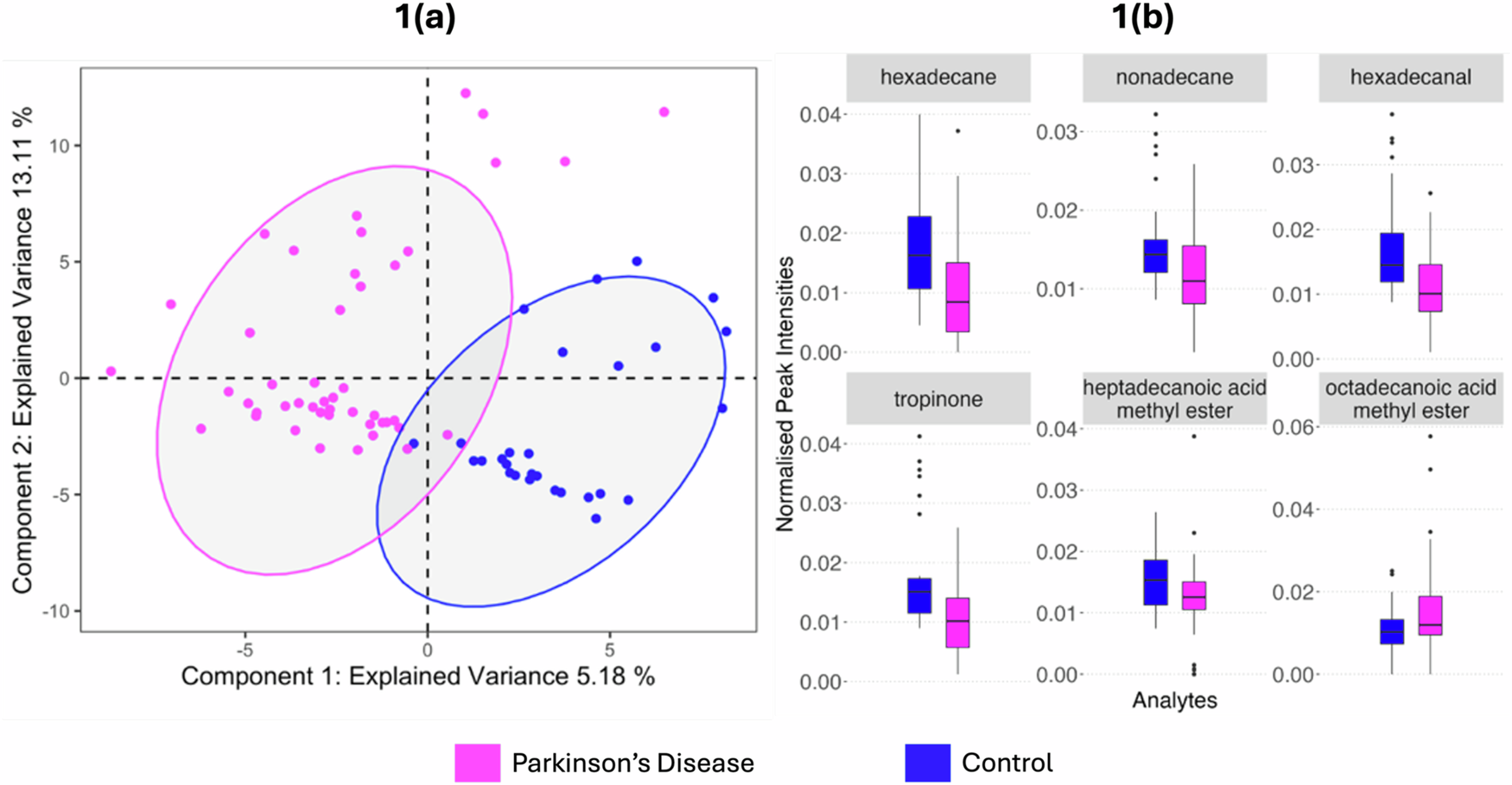
Research figure, not a portrait: chemical profiles from skin swabs in the 2025 study. Credit: Walton-Doyle, Heim, Sinclair et al., npj Parkinson’s Disease, Figure 1, CC BY 4.0. Image unmodified.
Turning a smell into something measurable
Milne has an unusually sensitive sense of smell, known as hyperosmia. Researchers did not try to turn everyone into a super-smeller. They set out to identify what her nose was detecting and whether laboratory instruments could measure it.
In a study published online in March 2019, scientists examined sebum samples from 64 people, including 43 with Parkinson’s and 21 controls. Sebum is the waxy, oily substance produced by glands in the skin. The samples came from participants’ upper backs, where earlier testing had suggested the distinctive odor was particularly noticeable.
The team used chemical analysis to look for differences in volatile compounds, the molecules that can escape into the air and contribute to a smell. Their findings included altered levels of compounds such as perillic aldehyde and eicosane. Milne helped evaluate whether the chemical scents resembled the odor she associated with Parkinson’s.
That was the crucial change in the story: a sensation experienced by one person had led to measurable differences in biological samples. It also left plenty of work to do before a research finding could become a reliable medical test.
The cotton-swab possibility
In September 2022, Manchester reported another step. A study comparing 79 people with Parkinson’s and 71 controls used mass spectrometry to examine skin-oil compounds collected with cotton swabs.
The reported laboratory method could move from swab to results in as little as three minutes. That timing described the analytical procedure, not a promise that a patient could walk into any clinic and receive a definitive diagnosis three minutes later.
The researchers described a potentially practical sampling process: collect sebum from the upper back and send it to a laboratory. A simple swab has obvious appeal compared with more demanding ways of collecting biological material. At the time, the team explicitly said its next focus was translating the findings into a test with clinical usefulness.
Could the clues appear earlier?
A July 15, 2025 study pushed the investigation toward an especially difficult question: whether skin chemistry might reveal changes before the familiar movement symptoms of Parkinson’s appear.
That research analyzed samples from 46 people with established Parkinson’s, 28 controls and nine people with isolated REM sleep behavior disorder, a condition associated with increased risk of later neurodegenerative disease. Some chemical features in the sleep-disorder group fell between those seen in the Parkinson’s and control groups.
In smell testing, three samples from that small sleep-disorder group were classified as Parkinson’s-like. Two of those participants showed Parkinson’s symptoms at clinical follow-up. Those observations are intriguing, but nine participants are a small foundation for broad predictions. The results support further investigation, rather than establishing a dependable early-warning system for everyone.
Why the careful wording matters
Research does not always produce the same chemical shortlist. A separate 2025 study involving 52 people with Parkinson’s and 28 controls found a significant difference in perillic aldehyde, while two other compounds it examined did not show significant group differences.
That helps explain why a striking origin story cannot stand in for validation. Scientists need to establish which signals are consistent, how sampling affects them and how well an approach distinguishes Parkinson’s from other conditions. A change in someone’s body odor is not, by itself, a diagnosis.
Milne’s contribution remains remarkable without turning it into a miracle claim. She noticed something in ordinary life that gave researchers a new question, then helped them investigate it. The lasting payoff is a growing body of evidence about information our skin may carry, and the possibility that an observation once detectable by an exceptional nose could eventually become useful to many more people.
Watch: Joy Milne and Perdita Barran discuss the research at the Royal Institution.