A 47-million-year-old owl from Germany’s Messel Pit preserved more than bones. Its wing and tail feathers survived, and so did the remains of its last meal: an iridescent cockroach. Together, those details suggest that this tiny ancient owl hunted in daylight, long before the stealthy nighttime lifestyle of most living owls became the family’s signature.
The fossil does not come with a clock showing when the bird ate. Instead, researchers built the case from several independent clues: the prey’s reflective coloration, the owl’s feather structure, and unusually stout wing bones. None proves daytime activity alone. In combination, they turn a spectacular fossil into evidence for when owls may have moved into the night.
A nearly complete owl, minus the skull
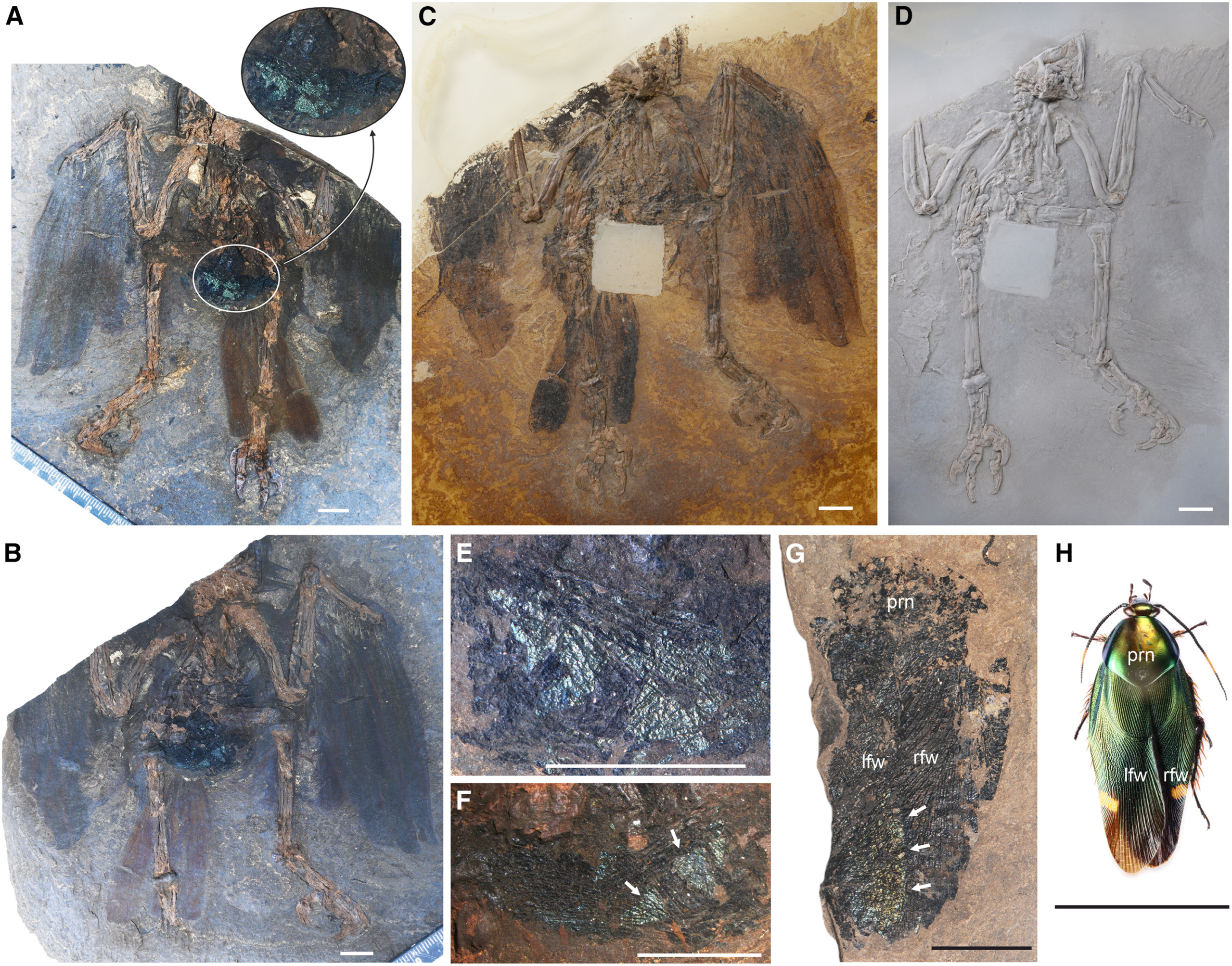
The species is named Masillastrix blattophaga. The genus name points to Messel, while the species name means “cockroach eater.” The specimen is only about 12 centimeters long and is nearly complete apart from its missing skull. According to the Senckenberg Research Institute’s account of the study, its skeleton, wing outline, tail feathers and stomach contents were all preserved in the oil-shale deposits of the Messel Pit.
That level of preservation is what makes the argument possible. A loose bone can reveal size and anatomy. A whole body with feathers and food can reveal behavior—or at least narrow the possibilities far more sharply.
The researchers describe the animal in Current Biology. It belongs to an archaic owl lineage rather than the group containing living owls. Its body proportions also depart from the familiar modern blueprint. The upper wing bone, or humerus, is short and sturdy, a build that does not match the long, specialized wings of many quiet nocturnal hunters.
The cockroach still carries a daytime clue
Inside the fossil’s body cavity are remains of a cockroach whose wings retained evidence of iridescent coloration. Iridescence depends on microscopic structures that bend and reflect light, creating colors that change with viewing angle. In living insects, that display needs light to be seen.
The team argues that a conspicuously iridescent cockroach would most plausibly have been active in daylight, when its visual signal could function. If the owl caught that insect while it was active, the meal becomes a clue that the predator was also hunting by day.
There are limits to the inference. A daytime insect can hide in a place where a predator finds it at dusk, and fossil color structures do not reconstruct an entire daily routine. The study therefore treats the cockroach as one strand of evidence rather than a magical timestamp.
Its feathers were not built like silent-flight equipment
Modern nocturnal owls are famous for wings that reduce the sound of air moving across feathers. Their flight feathers often carry comb-like leading edges, soft fringes and velvety surfaces that break up turbulence. That acoustic engineering helps an owl approach prey that may hear better than it sees.
The preserved feathers of Masillastrix do not show the same suite of silent-flight adaptations. The study also notes the stout humerus, which would have supported a different style of flight from many living owls. These anatomical clues fit a bird that did not yet rely on near-silent nocturnal attacks.
Again, absence is not absolute proof. Soft feather structures can be difficult to preserve, and an extinct bird may combine traits in ways that have no perfect modern comparison. But the fossil is unusually complete, and the feather evidence points in the same direction as the last meal.
When did owls inherit the night?
The Messel owl lived about 47 million years ago. Fossils from roughly 34 to 35 million years ago already show more modern owl adaptations associated with nocturnal hunting. That leaves a window of roughly 12 million years in which the shift toward the night may have occurred.
Why move into darkness? Competition is one possibility. Birds of prey dominated daytime skies, while mammals were diversifying below. Night offered a different set of prey and fewer direct competitors, but it also rewarded better low-light senses and quieter flight. Evolution could then reinforce the very features that make a living owl look and sound so unlike a hawk.
The new fossil cannot identify one cause or date the change to a single moment. It does something more useful: it places a well-preserved, apparently daytime-hunting owl on the earlier side of the transition and gives researchers anatomical and ecological evidence to compare with younger species.
A last meal becomes an evolutionary timestamp
The payoff is not merely that an owl once ate a cockroach. The insect’s preserved shimmer, the owl’s unspecialized flight feathers and its sturdy wing bones all support the same interpretation: some early owls were still daytime predators. The nocturnal identity we now treat as inseparable from owls was probably assembled later.
Current reporting and additional fossil images are available from Live Science. Featured image: composite scientific plate showing the Masillastrix blattophaga holotype and preserved Messel cockroaches. Credit: G. Mayr, L. Šmídová, A. Richter and S. Wedmann, via Wikimedia Commons, used unchanged under the Creative Commons Attribution 4.0 license.