A fossil no longer than a house cat spent 156 million years keeping its best clue inside a block of Wyoming sandstone. Only a string of neutron and X-ray scans revealed the nearly complete skull of Meilynodraco amonamarthi, a newly named reptile with two hornlike projections at the back of its head.
The discovery is a wonderfully improbable chain reaction: an imaging scientist left his business card at a dinosaur museum during a family visit, the museum called ten days later, and tens of thousands of digital slices eventually turned a few dark bones in rock into the most complete early member of an enigmatic reptile group. The creature was not a baby dinosaur or a snake. It was a choristodere—and its inner ear may help redraw that group’s disputed place on the reptile family tree.
The mystery started with a barely visible spine
An Aathal Dinosaur Museum team found the fossil in Wyoming’s Meilyn Quarry in August 2022. A row of tiny vertebrae was visible in sandstone, but much of the animal remained buried. The possibilities ranged from a juvenile dinosaur to an early crocodile relative. Physical preparation risked destroying bones that were both small and inaccessible.
Then materials scientist Pavel Trtik visited the Swiss museum with his sons in January 2023. Trtik works at the Paul Scherrer Institute, where neutron imaging can expose structures hidden inside solid material. He offered the museum his card in case it ever had a difficult specimen. Ten days later, the museum called about the Wyoming fossil.
Neutrons were especially useful because they respond strongly to hydrogen, including hydrogen in hydroxyapatite, a mineral component of bone. X-rays supplied complementary information. Researchers combined scans made at PSI, Empa and the University of Zurich, then reconstructed pelvic bones, a hind leg and a skull whose braincase measured less than two centimeters across.
The tiny skull changed the identification
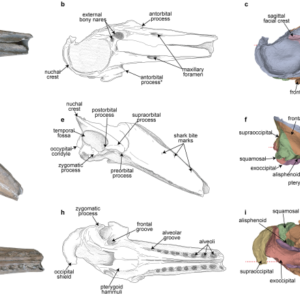
The digital model showed an animal about 45 centimeters long with a pair of pointed projections behind its head. Its anatomy placed it among the choristoderes, semi-aquatic or aquatic reptiles that survived for more than 150 million years but left scientists an awkward evolutionary puzzle. Their unusual skull bones have made it difficult to decide exactly how they relate to other reptiles.
The newly exposed inner-ear bones resemble those of crown-group reptiles—the group containing all living reptiles—more closely than earlier choristodere fossils did. The researchers describe that resemblance as a clue, not a final verdict. It suggests choristoderes could sit closer to living reptiles than some previous evidence indicated.
The specimen is also the oldest choristodere record known from North America and the most complete early-branching member of the group yet described. That combination gives paleontologists a rare anatomical reference point near the beginning of the lineage rather than another fragment from much later in its history.
Its metal name is not a marketing invention
The animal’s name carries both geology and a very loud playlist. Meilynodraco roughly means “Dragon of Meilyn,” after the quarry and the hornlike skull. The species name amonamarthi honors Swedish melodic death-metal band Amon Amarth. Paleontologist Torsten Scheyer, a fan of the band and J.R.R. Tolkien, thought the digitally reconstructed little dragon deserved a suitably metal name.
Amon Amarth itself takes its name from Tolkien’s Sindarin term for Mount Doom. That gives the fossil a three-step nerd lineage: Jurassic reptile, death-metal band, Middle-earth volcano. The name is playful, but the paper behind it is peer reviewed. It appeared in Royal Society Open Science on November 18, 2026.
What the scans do and do not show
The fossil’s head and torso were separated. Researchers cannot determine why. A predator may have been involved, but that remains a possibility rather than a reconstructed death scene. What the scans establish is the animal’s anatomy inside the rock, not the exact events that buried it.
That restraint makes the real payoff better. A nearly invisible skull, smaller than a coin is wide, carried enough anatomy to identify a new species and challenge ideas about a mysterious reptile branch. The decisive tool was not a chisel but a beam of neutrons, activated because one scientist happened to leave a business card beside the dinosaurs.
Primary sources: Paul Scherrer Institute’s November 19 media release and the peer-reviewed paper in Royal Society Open Science.
Featured image credit: Aathal Dinosaur Museum, via the Paul Scherrer Institute. The image shows the first fossil-bearing sandstone slab with visible torso bones. PSI states that the release’s images are available free of charge for media coverage of this research.