The stars did their part. Over billions of years, they manufactured oxygen inside 37 nearby dwarf galaxies. Yet when astronomers added up the oxygen those galaxies still contained, the average came to only about 11% of the amount their stars were estimated to have produced.
That is the striking result of the Galaxies Losing Oxygen via Winds project, or GLOW, described in a November 2 release accompanying publication in The Astrophysical Journal. The galaxies retained between 4% and 25% of their oxygen. The missing material creates a problem for simulations that predict these small systems should keep considerably more of it.
A chemical inventory with a very large shortfall
The researchers reconstructed the galaxies’ star-formation histories using individual stars resolved in Hubble images. That let them estimate how much oxygen generations of stars should have supplied. They then compared that production with the oxygen remaining in the galaxies.
This was not a photograph of a single cloud escaping. It was an inventory assembled from several kinds of evidence. Archival observations from Hubble and Spitzer, alongside radio measurements, helped connect the stellar history with the gas and other material present today.
Oxygen is especially useful for this accounting because astronomers can measure it and understand its stellar production. Following it also helps reveal what happens to other elements made by stars. The question reaches beyond what a galaxy contains: it asks how galaxies supply material to the space around them.
The surroundings seem to matter
The research paper, first posted as a preprint in August before its November journal publication, reports that nearly all the oxygen still retained in these low-mass galaxies resides in their gas. It also identifies a possible environmental influence: galaxies in denser surroundings, or near a much more massive neighbor, show greater scatter toward higher retention.
That pattern suggests a galaxy’s neighborhood can affect how material is retained, recycled or acquired. But a familiar relationship between galaxy mass and chemical enrichment did not straightforwardly predict how much oxygen each galaxy had kept. A simulation can reproduce that relationship while still getting the oxygen inventory wrong.
The missing oxygen has not vanished
The leading explanation involves outflows powered by massive stars and supernova explosions. Those winds appear to remove enriched material more effectively than current models expect. Where most of it ends up remains unresolved.
Some oxygen has been detected in the extended gas around dwarf galaxies. The open question is whether that surrounding reservoir holds most of the missing material, or whether much of it has traveled farther into intergalactic space.
That gives this cosmic mystery a concrete next step: account for the material outside the galaxies as carefully as the stars inside them. The stars supplied the oxygen. Finding its destination would show how much influence a small galaxy can have beyond its visible edge.
Sources: NASA’s November 2 research release; Rutgers University; McQuinn and colleagues, GLOW II.
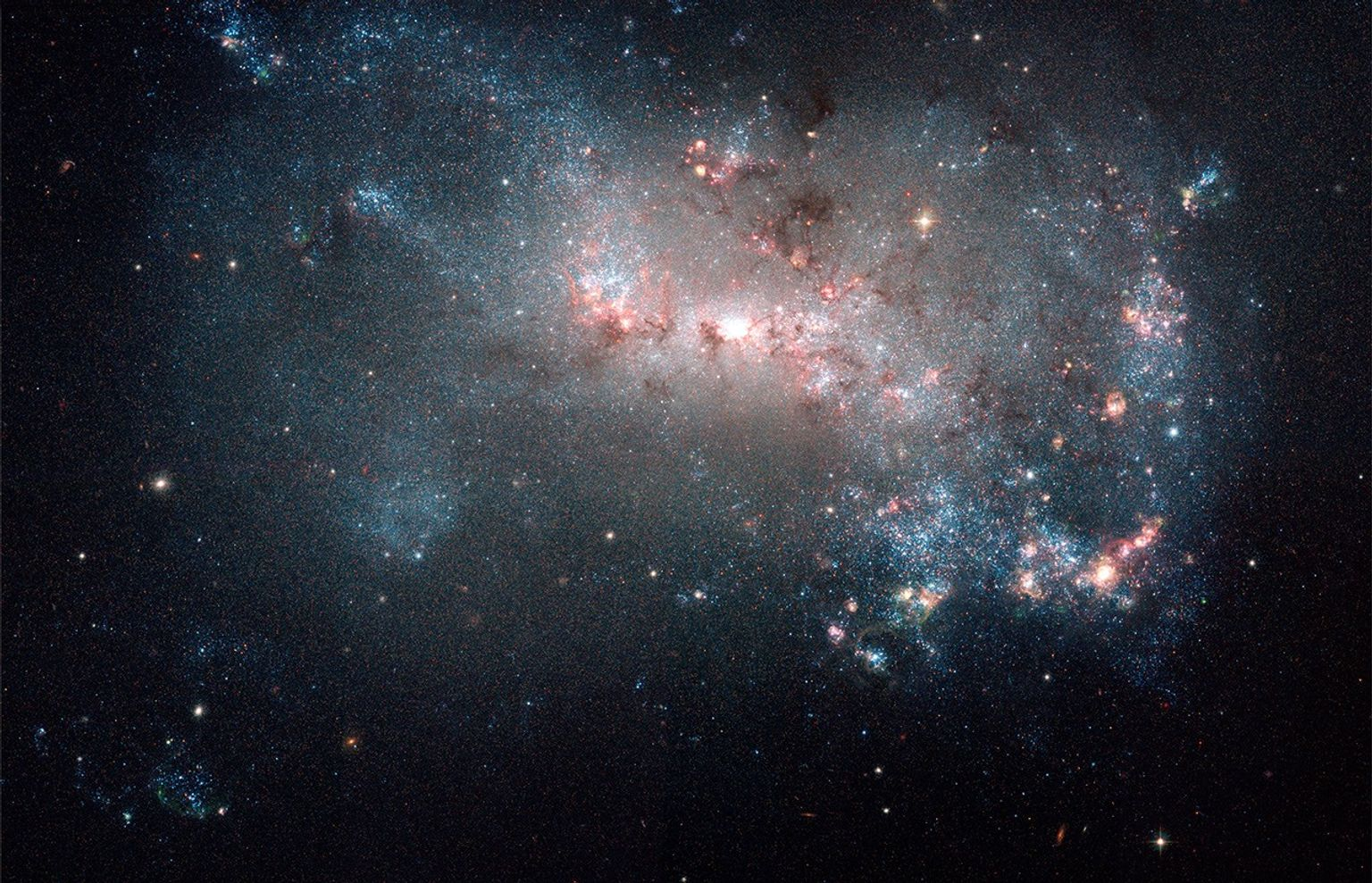
Image: Archival Hubble image of NGC 4449, one of the galaxies in the GLOW study. Credit: NASA, ESA, Hubble Heritage–ESA/Hubble Collaboration, Alessandra Aloisi (STScI, ESA). This shows the galaxy, not a direct image of its missing oxygen. Used for informational editorial coverage under NASA media guidelines; no endorsement is implied.