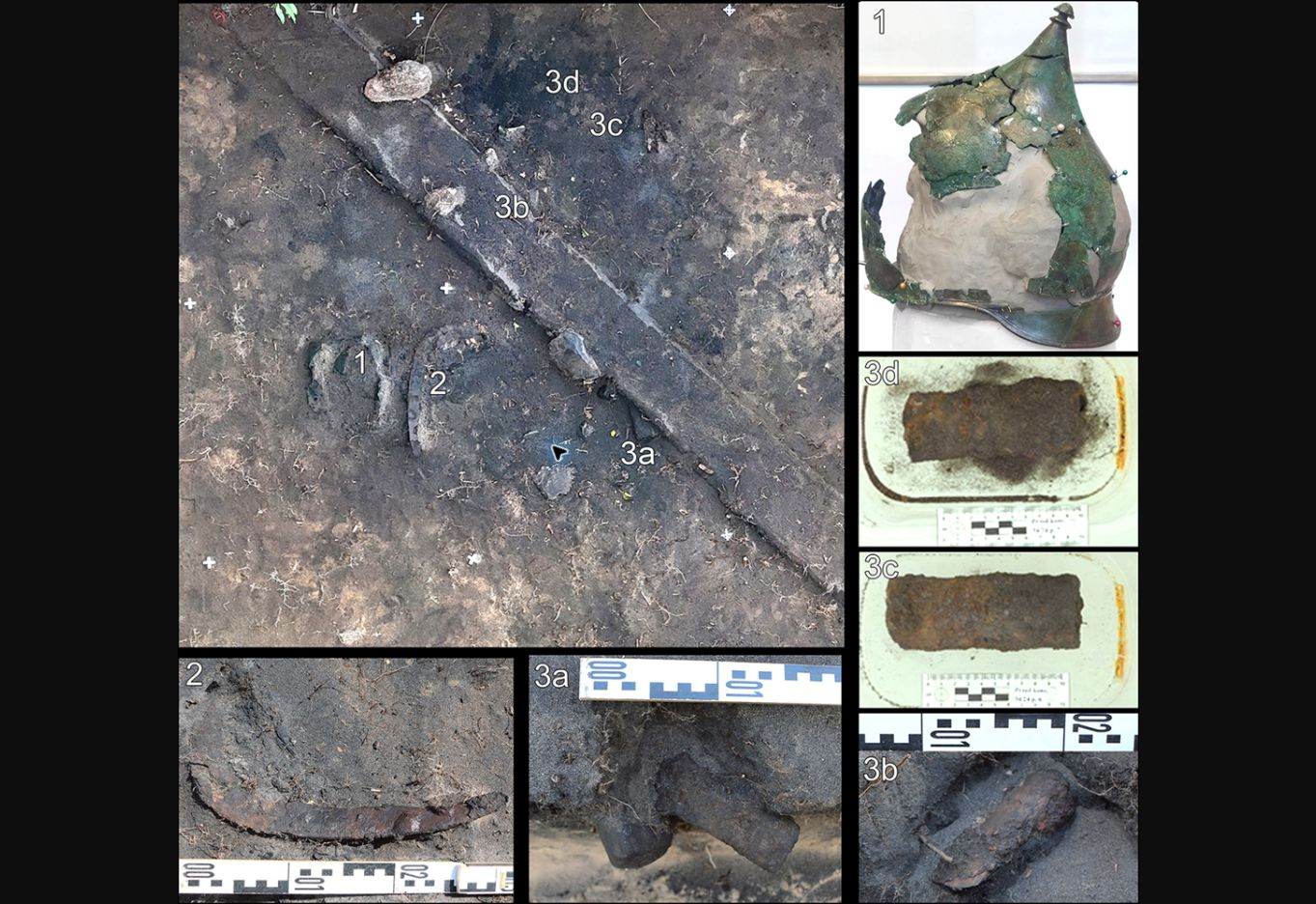
A rare Celtic helmet was not buried with a warrior or lost in battle. About 2,400 years ago, someone crushed it, broke it into pieces and placed it in a charred pit with a scythe and four iron adzes at Łysa Góra in north-eastern Poland. The location is the real surprise: this type of bronze helmet belonged to the La Tène world far to the south, and researchers say no comparable fourth-century B.C. example is known so far outside that cultural zone.
The discovery itself was made after excavations resumed in 2024, but a newly published open-access study in Antiquity puts the helmet back into its archaeological neighborhood. That wider evidence—fortifications, metalworking debris, amber, imports and ritual deposits—turns one smashed object into a much larger question: were Celtic traders merely passing goods north, or were Celtic people actually living at this Baltic-edge settlement?
The helmet looked like a vessel until its point appeared
Łysa Góra, whose name means “Bald Hill,” is a glacial sand dune between the Orzyc River and an oxbow lake in northern Mazovia. It was occupied between the sixth and fourth centuries B.C. by people associated with the West Balt Barrow Culture. Archaeologists first identified the site in 1957 and excavated it intermittently from 1971 to 1992, but much of that work was never comprehensively published.
When the State Archaeological Museum in Warsaw and the University of Warsaw returned in 2024, the place already had a reputation for being badly disturbed. The helmet did not arrive with cinematic fanfare. Lead author Bartłomiej Kaczyński told Phys.org that the bronze sheet first looked like a vessel. Only when the pointed top emerged did the team realize what they had found.
The object is a Berru-type helmet, a form associated with elite Celtic warriors and known from places such as Dürrnberg in Austria. It had been deliberately crushed and fragmented before burial. In the same pit were a scythe, four adzes and charred remains. That arrangement is why the researchers interpret the deposit as ritual activity rather than a forgotten toolbox with unusually impressive headgear.
One prestigious object is not the whole argument
A helmet can travel without its owner. The paper is careful about that possibility, describing indirect exchange as an alternative that cannot yet be excluded. Smaller La Tène ornaments reached distant parts of Europe, so an exotic object alone would not prove migration.
Łysa Góra, however, has produced a pattern rather than a lone curiosity. The team reports nearly 350 metal artifacts, including weapons, ornaments and evidence of bronze working. Thirty-one mostly fragmentary La Tène brooches and ring ornaments date to around the middle of the fourth century B.C. Excavators also found amber beads and an unfinished amber ring, bundles of bronze apparently prepared for remelting, casting crucibles, animal bones, grain and cultivated plant seeds.
The site was fortified with timber-and-earth structures and sat near the amber-rich Kurpie region, on routes leading north toward the Sambian Peninsula. In the researchers’ interpretation, it could have served as a fortified production center, ritual place and trading hub on the Amber Route. That combination makes the helmet more difficult to explain as a random luxury item that wandered north one transaction at a time.
Why a helmet may have been socially stranger than it looks
In the La Tène world, helmets could mark high rank and membership in a warrior elite. The study contrasts that hierarchy with the local communities of north-eastern Poland, which the authors describe as probably acephalous—organized without an obvious central ruler. A prestige object designed to announce one person’s status may therefore have carried a social meaning that did not fit the surrounding culture at all.
That is the article’s most intriguing payoff. The helmet is not simply “Celtic” because of its shape; it represents a particular way of displaying power. Finding it in a local ritual context raises the possibility that southern visitors, perhaps including members of an elite group, helped establish or maintain this stretch of long-distance exchange.
The evidence does not yet identify the wearer, prove a permanent Celtic colony or explain exactly why the helmet was destroyed. The authors call their interpretation a hypothesis. Planned metallurgical work and lead-isotope analysis may help trace the bronze’s ore source, while further surveys could clarify how the fortifications and activity areas fit together.
A broken object becomes evidence because its context survived
The temptation is to imagine the helmet’s last owner and write the missing adventure ourselves. Archaeology offers something better: a pit whose contents can be compared with the settlement around it. The scythe and adzes, the charred fill, the amber-working evidence and the wider concentration of La Tène objects all constrain the story even when they cannot finish it.
Łysa Góra now looks less like an isolated hill with a glamorous import and more like a busy frontier node where local traditions met people and objects moving across Europe. The helmet was crushed, but the network it belonged to is becoming visible.
Featured image: Figure 6 from Kaczyński et al., “Łysa Góra in north-eastern Poland: a key Early Iron Age site on the ‘Amber Route,’” showing the pit, the reconstructed helmet and associated tools. Photograph by Bartłomiej Kaczyński. Reused under CC BY 4.0.