A fish can need a vaccine before it is big enough for a practical injection. Researchers at MIT and the U.S. Department of Agriculture are trying to close that gap with needles made from silk—and a coating that stops them dissolving before they do their job.
In a November 2 announcement, the team described underwater delivery in rainbow trout weighing just 1–2 grams. USDA researcher Gregory Wiens said conventional needle vaccination is difficult below roughly 30 grams. Their single-use microneedles penetrate wet skin, remain attached as the fish swim and release vaccine material.
The needle has to survive water, then let its cargo go
Silk alone softened too quickly. The researchers added shellac, an insect-produced resin also used in food coatings, as a temporary moisture barrier. Different versions released their contents over minutes or hours. The new ACS Nano paper describes the design, but MIT says further development is needed before farm-scale deployment.
The interesting engineering trick is not simply making a smaller syringe. It is controlling when water gets in: too early, and delivery fails; at the right point, the material can release what it carries.
This is a delivery problem, not a miracle-vaccine announcement
The project has a history. In a 2024 Materials Research Society presentation, Meng Li, Wiens and Benedetto Marelli described hollow microneedles tested with zebrafish and juvenile rainbow trout. Their abstract explained the practical motivation: individual injections require handling and anesthesia, expose workers to accidental needle sticks and leave needle waste to dispose of.
That earlier pilot also shows why delivery and protection must not be confused. In groups of 60 trout, the abstract reported 65 percent mortality after a bacterial challenge in microneedle-vaccinated fish, compared with 85 percent in a control group. The authors explicitly said optimization was needed for on-farm effectiveness. Those are historical pilot results—not a claim about the new paper’s final performance.
The smallest fish are the point
On her research page, Li frames the goal as precise underwater vaccination that could eventually be automated. The ambition is to reduce manual work while replacing disposable conventional needles with biodegradable materials. That is a development goal, not a machine already operating throughout the industry.
For a hatchery, success would mean more than an elegant laboratory device. It would mean treating vulnerable fish earlier without making the job harder for the people caring for them. The next test is whether a clever material can become a reliable farming tool. Tiny patients make the challenge larger, not smaller.
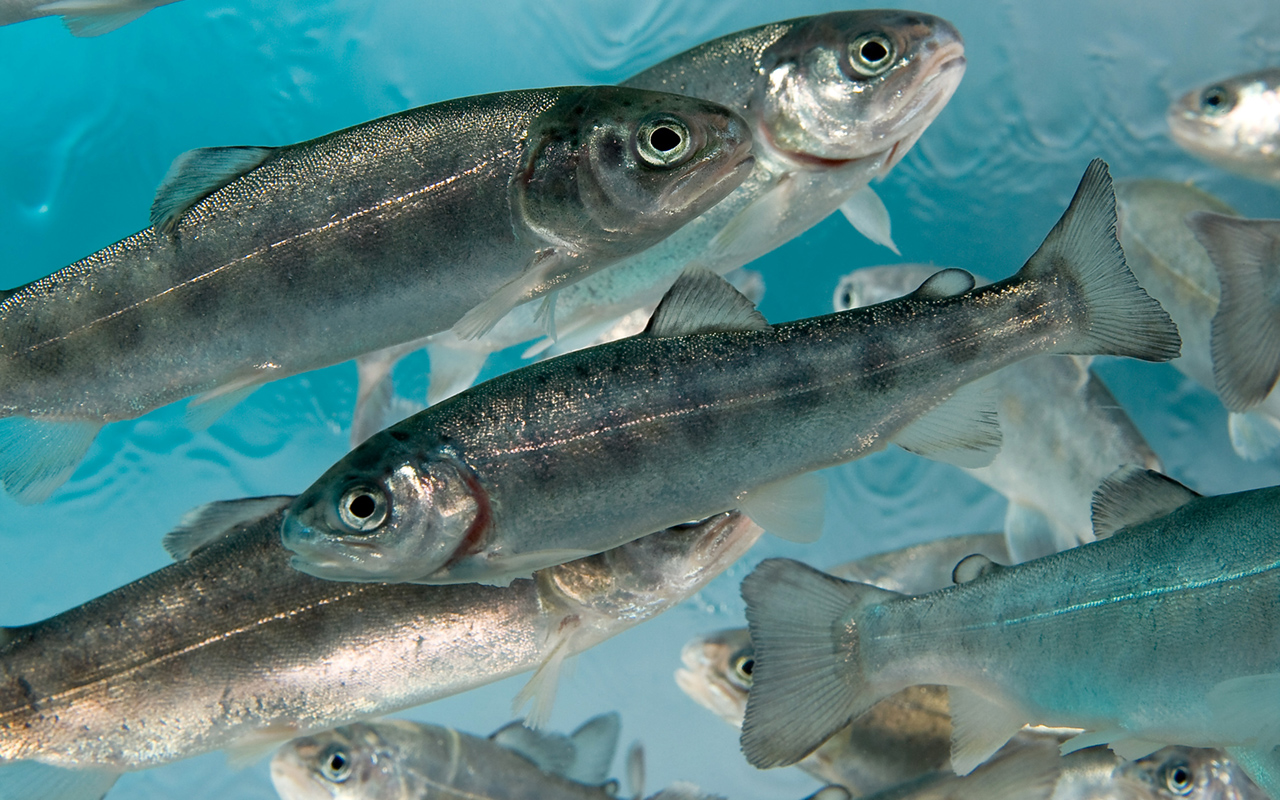
Image: Juvenile rainbow trout at USDA’s National Center for Cool and Cold Water Aquaculture in Leetown, West Virginia. Photograph by Steve Ausmus, USDA/ARS, image D1946-4; public domain. Context photograph, not the fish used in the new microneedle experiments.