Four people spent 378 days pretending they lived on Mars. When the door finally opened in Houston on October 31, mission commander Ross Elder signed off with a reference to The Truman Show.
The joke fit. Ross Elder, Ellen Ellis, James Spicer and Matthew Montgomery had spent more than a year inside NASA’s second CHAPEA simulation, sharing a world that was deliberately smaller, slower and more isolated than the one waiting outside. Their return, covered in NPR’s November 1 report from Houston, brought reunions with family and friends—and sunlight instead of simulated Martian scenery.
The hard part was not the fake red dirt
The Crew Health and Performance Exploration Analog mission took place in a 1,700-square-foot, 3D-printed habitat at Johnson Space Center. NASA’s mission description lists familiar astronaut chores: maintenance, exercise, plant cultivation and simulated spacewalks. The crew entered on October 19, 2025.
What made those ordinary tasks unusual was the absence of ordinary support. Communications were delayed, resources constrained and the same four people remained together throughout the mission. NPR reported that message delays could reach 44 minutes for a round trip. The simulation also included a two-week communications blackout, representing the disruption that can occur when the Sun lies between Earth and Mars.
A mission-control conversation that takes that long cannot work like a phone call to a helpful friend. It changes when a crew must make decisions for itself—and how carefully it must describe a problem before asking for help.
They made a band, not just a schedule
CHAPEA investigator Suzanne Bell told NPR that the crew found creative ways to fill downtime, including forming a band. That detail is more than a charming footnote. Spending a year with three companions is a social experiment as well as an operational one; getting through the checklist is not the same as finding a life inside it.
NASA’s final crew audio log describes the project as human research, rather than a technology demonstration or full dress rehearsal for a Mars expedition. The distinction matters. A Houston habitat is not another planet. It lets investigators examine selected pressures of a long mission without claiming to reproduce every hazard of deep space.
Walking outside was not the end of the experiment
Reuters reported on November 1 that the team would undergo two weeks of evaluations and debriefings. NASA wants lessons that can improve food systems, workload planning, medical support and the management of communications on future missions.
Those lessons are not a published verdict that humans are ready for Mars. The confirmed achievement is narrower and still remarkable: four volunteers completed an unusually long, deliberately restricted life together, leaving researchers a record of how they handled it.
Their homecoming supplies the emotional ending. The useful scientific ending will come from what investigators learn after the door has closed behind them.
Watch: NASA Johnson’s CHAPEA Mission 2 exit ceremony.
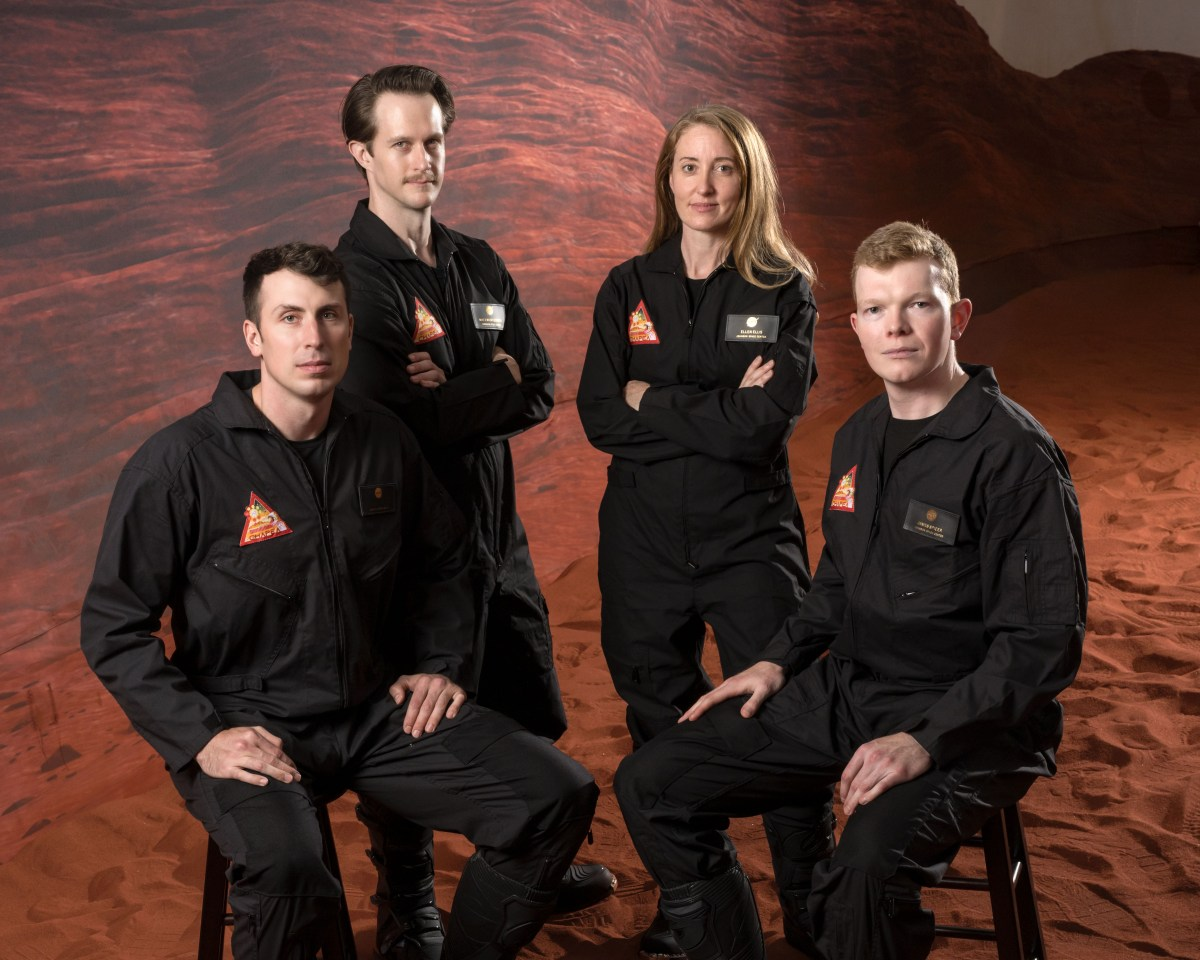
Featured photograph: CHAPEA Mission 2 crew members Ross Elder, Matthew Montgomery, Ellen Ellis and James Spicer, from left, photographed October 8, 2025, before their isolation mission. Credit: NASA. This is a pre-mission portrait, not a photograph of the October 2026 exit ceremony.