Voyager 1 went quiet for 48 hours in October. Then its signal returned before NASA sent commands to investigate the problem.
According to NASA’s October 29 update, the Deep Space Network detected no signal during scheduled contacts on October 18 and 19. Contact resumed October 20 and had continued through the report.
Engineers found that a thruster group had switched off and backups had activated. The spacecraft can make that change automatically when its computers detect trouble. The cause of the communications loss remained under investigation; the returning signal alone did not explain what happened.
A message that takes a day to arrive
The timing gives this episode extra weight. NASA expects Voyager 1 to reach one light-day from Earth on November 18, 2026. That is roughly 16.1 billion miles, a distance so large that even light needs 24 hours to cross it.
Radio signals travel at light speed, too. At that distance, a command needs a day to reach the probe, and a reply needs another day to come back. Even an immediate response aboard the spacecraft would leave controllers waiting roughly two days to hear it.
For comparison, sunlight reaches Earth in about eight minutes and 20 seconds. Voyager 1 has spent nearly half a century covering a distance light crosses in a single day. Its twin took a different route through the planets and is expected to reach the same distance from Earth in November 2035.
Keeping a 1977 spacecraft working
There is another constraint besides distance: electricity. NASA’s earlier explanation of Voyager’s power-saving work describes generators that turn heat from decaying plutonium into electrical power. Each probe loses about four watts of available power per year.
The team’s solution, nicknamed the “Big Bang,” substitutes lower-power devices for existing ones while preserving enough warmth to keep the spacecraft operating. Voyager 2 completed that operation first. NASA said its savings would let that probe’s three science instruments operate for at least an additional year.
The October update confirms Voyager 1 completed its own swap in early September. Without it, another instrument could have needed to shut down as early as summer 2027.
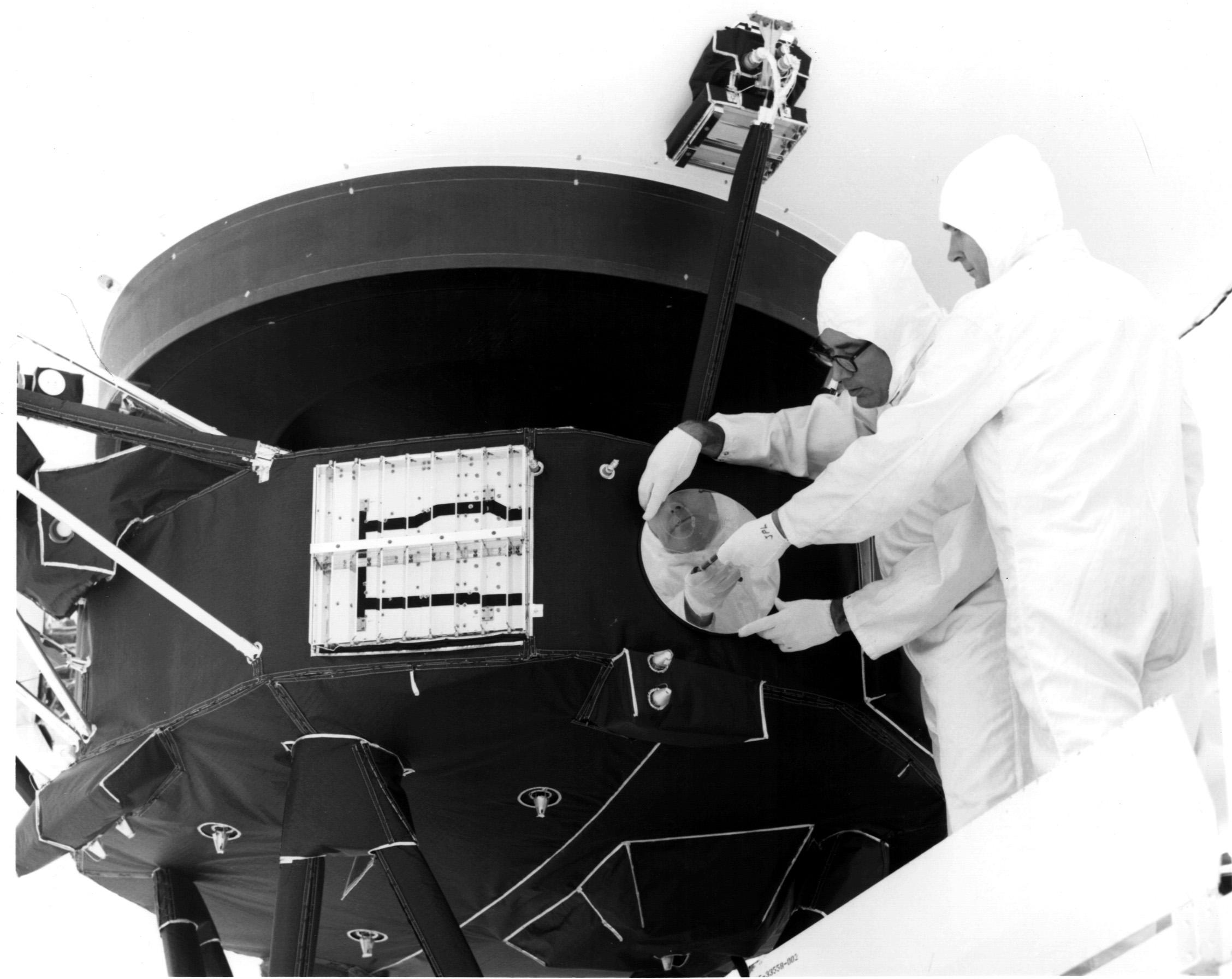
Voyager 1 launched on September 5, 1977, visited Jupiter and Saturn, and entered interstellar space in August 2012. Its planetary encounters revealed a faint ring around Jupiter and new moons. Its later mission extended exploration beyond the Sun’s surrounding bubble of particles and magnetic fields. It also carries a Golden Record containing sounds, music, greetings and images from Earth. The archival photograph accompanying this story shows engineers securing its record cover before launch.
That physical message is still traveling outward with the spacecraft. For now, the radio link gives people back home something more immediate: a way to keep listening to humanity’s most distant explorer.
Image: Engineers secure the cover of Voyager 1’s Golden Record in 1977. Credit: NASA/JPL-Caltech. Official archival photograph, used for informational editorial coverage under NASA media guidelines. No endorsement is implied.