A dinosaur unearthed in a Surrey brickworks 25 years ago has finally been recognized as a new genus and species. Its name, Paludohadros proudlovii, carries a human story almost as striking as the fossil: it honors Will Proudlove, the quarry manager who was fascinated by the bones emerging from the clay but died shortly before this animal was excavated.
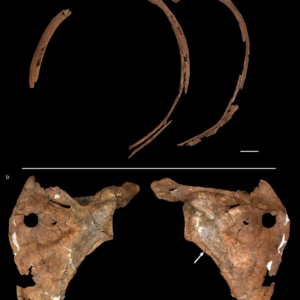
The discovery is not simply an old skeleton receiving a new label. Researchers concluded that the five-meter juvenile had been incorrectly grouped with better-known British iguanodontians. Re-examining its skull and skeleton after recent revisions to the dinosaur family tree revealed a combination of features that did not fit Iguanodon or Mantellisaurus. The fossil had been visible for decades; the scientific framework needed to recognize it had finally caught up.
A new dinosaur with a family name
The Natural History Museum announced the species on October 27, alongside publication of its formal description in the Journal of Systematic Palaeontology. The genus name combines the Latin word for swamp with a root commonly used for hadrosauroids, reflecting the muddy wetland environment of southern England roughly 125 million years ago.
The species name proudlovii commemorates Proudlove, who rose through the ranks at the Ewhurst brick and roof-tile works and became its manager. He died at 35 in 2000, leaving his wife Rachael and their young children, Ellie and Matt. The dinosaur was discovered the following year.
Rachael and the children were invited to watch the excavation in 2001. A quarter-century later, they learned that the animal was not only a new species but a new genus. In the museum’s announcement, Rachael described the naming as a way for Will’s name and legacy to continue. That gives the Latin binomial unusual emotional weight: this is taxonomy doubling as remembrance.
Why it took 25 years to recognize
Britain has a long history with iguanodontians, the mostly plant-eating dinosaurs famous for the thumb spikes seen in animals such as Iguanodon. For years, fossils from southern England were often assigned to Iguanodon or the smaller Mantellisaurus, especially when the remains were incomplete.
That changed as scientists redescribed Mantellisaurus in much greater anatomical detail in 2023. A better definition of the familiar animal made it easier to spot fossils that did not belong with it. Ricardo Sacamoto and his colleagues could compare the Surrey skeleton bone by bone and identify a distinct set of characteristics.
The process is a useful reminder that museum collections are not warehouses where science goes to sleep. A fossil can be collected, prepared and cataloged without surrendering its entire story. New comparisons, revised family trees and better descriptions can turn a specimen everyone already knows into an animal nobody had named.
The juvenile was already the size of a rhinoceros
The known individual measured about five meters long and weighed an estimated 1.5 to two tonnes—roughly rhinoceros territory. Its bones, however, do not appear fully developed. The researchers think it was a juvenile and suggest a mature adult might have grown about twice as large.
Its body plan belonged to a transitional chapter in dinosaur evolution. Paludohadros was a hadrosauroid, part of the broader lineage that eventually produced the elaborate duck-billed dinosaurs of the Late Cretaceous. It still retained the sturdy build and thumb-spike heritage associated with earlier iguanodontians.
The name also restores the animal to its landscape. Early Cretaceous Surrey was not a neat green lawn with dinosaurs placed at tasteful intervals. It was a wet, muddy environment crossed by channels and inhabited by several large species. The quarry that preserved Paludohadros had already produced one of Britain’s celebrity predators.
Baryonyx was found only 100 meters away
The remains were excavated roughly 100 meters from the location where Baryonyx walkeri was discovered in 1983. Baryonyx is famous for its crocodile-like snout, enormous hand claws and evidence of fish in its digestive tract. Its last meal also contained bones from a young iguanodontian.
That creates an irresistible possibility, but the evidence requires restraint. Researchers cannot identify the meal bones to species, so they do not know whether Baryonyx ate Paludohadros. Nor can they establish whether the predator hunted the juvenile or scavenged remains. The two dinosaurs came from the same site, and their biology makes the connection plausible—not proven.
The uncertainty is part of the payoff rather than a flaw. We now know that a rhino-sized juvenile iguanodontian lived in the same wetland represented by Baryonyx, and we know that the predator consumed some kind of young relative. The fossils put predator and potential prey in the same neighborhood without manufacturing a chase scene the rocks did not preserve.
The next new dinosaur may already have a catalog number
The reclassification has already sent researchers back through older material. The Natural History Museum says several additional Paludohadros specimens have been recognized among fossils collected during the 1950s. Sacamoto plans to examine more iguanodontian material as part of his doctoral research, meaning other overlooked species may be waiting in the same collection.
That is what makes Paludohadros proudlovii more satisfying than a one-day naming announcement. The discovery connects an evolving scientific puzzle, a famous neighboring predator and a family whose father helped make fossil work possible. Twenty-five years after the clay gave up the skeleton, it finally has a name—and Will Proudlove is part of it.