The rock samples had already survived a trip up from the deep Pacific. The surprise came in the laboratory, while researchers were breaking dried pieces by hand so they would fit inside a grinding vessel: two rocks began giving off heat and smoke before the machine was even switched on.
A new study traces that behavior to an unexpected mineral structure inside the samples. The rocks were dominated by tiny crystals of marcasite, an iron sulfide that had replaced an older mineral while preserving its blade-like shape. What looked like an ordinary piece of seafloor had become a porous, reactive material capable of heating itself as it oxidized.
From a deep-sea expedition to a laboratory problem
The samples came from Escanaba Trough, roughly 200 miles off northern California. During the 2022 expedition, scientists aboard the research vessel Thomas G. Thompson used the remotely operated vehicle Jason to explore a seafloor they could not visit directly. NOAA’s expedition account records 11 Jason dives, reaching depths of as much as 3,300 meters—just over two miles.
Those dives were collecting evidence about an entire underwater system, not searching for combustible stones. Researchers gathered rocks, biological specimens, sediments and vent fluids, while an autonomous vehicle mapped the terrain. They even found hydrothermal activity in an area previously considered inactive. The laboratory surprise belonged to a much larger effort to understand how this hidden landscape works.
At Escanaba, seawater circulates through hot rock, carries dissolved metals upward and deposits minerals as it cools. The USGS’s account of the expedition describes a sediment blanket that can trap heat and a mixture of active, cooling and long-inactive hydrothermal sites. A mineral deposit is not necessarily chemically frozen in the condition in which it formed.
The transformation inside the rock
In its October 7 explanation of the research, the USGS identifies nanocrystalline marcasite as the main component of the combusting samples. “Nanocrystalline” describes extremely small crystals. These had replaced blades of another iron sulfide, pyrrhotite, without erasing their original outline.
The distinction is not cosmetic. A replacement mineral can have different stability and reactivity from the material that came before it. Oxidation can release heat; under suitable conditions, that heat can encourage further self-heating. In these particular samples, the process went far enough to produce spontaneous combustion during handling.
This is why identifying a rock only by its overall appearance or metal content can miss something important. The arrangement and condition of its minerals matter too. A piece of ore can preserve the outline of an earlier crystal while its interior has changed into something that behaves differently.
Was there fuel hidden inside?
The peer-reviewed study, published September 28, examined 57 hydrothermal rocks; 41 contained metal sulfides as a major mineral. Two combusted, reaching more than 100 degrees Celsius and completely oxidizing. The authors compared them with samples that did not burn.
Petroleum was a plausible suspect in this sediment-rich environment, but the evidence pointed elsewhere. The self-heating did not track the samples’ organic-carbon content. Hydrocarbon-rich sediment tested separately did not show the same self-heating behavior. The unusual mineral structure, rather than an unnoticed pocket of fuel, became the central explanation.
The researchers also recorded the events. Their original clips are available as Supplementary Materials 1 and 2 on the study’s supplementary-information page. They are laboratory footage of the samples, not an animation of something imagined to happen underwater.
Not every seafloor rock is a fire waiting to happen
The USGS explicitly warns against that conclusion. These were particular samples from one location, not evidence that every massive-sulfide deposit will ignite. Its concern is what happens if such material is lifted, dried, handled and processed under conditions very different from those on the seafloor.
The practical lesson is narrower—and more interesting—than “the ocean contains burning rocks.” Bringing a specimen home can change the conditions that kept it comparatively stable. Before anyone assumes that safety practices for an old land-based deposit will cover a young seafloor deposit, this study gives them a specific reaction to investigate.
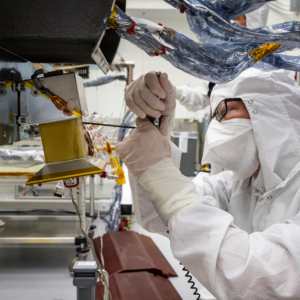
Featured image: an archival pyrrhotite-rich sulfide sample from Escanaba Trough, photographed in 2022 by Peter Pearsall/USGS; public domain. View the original photograph and record. This image does not identify either of the two combusting specimens.