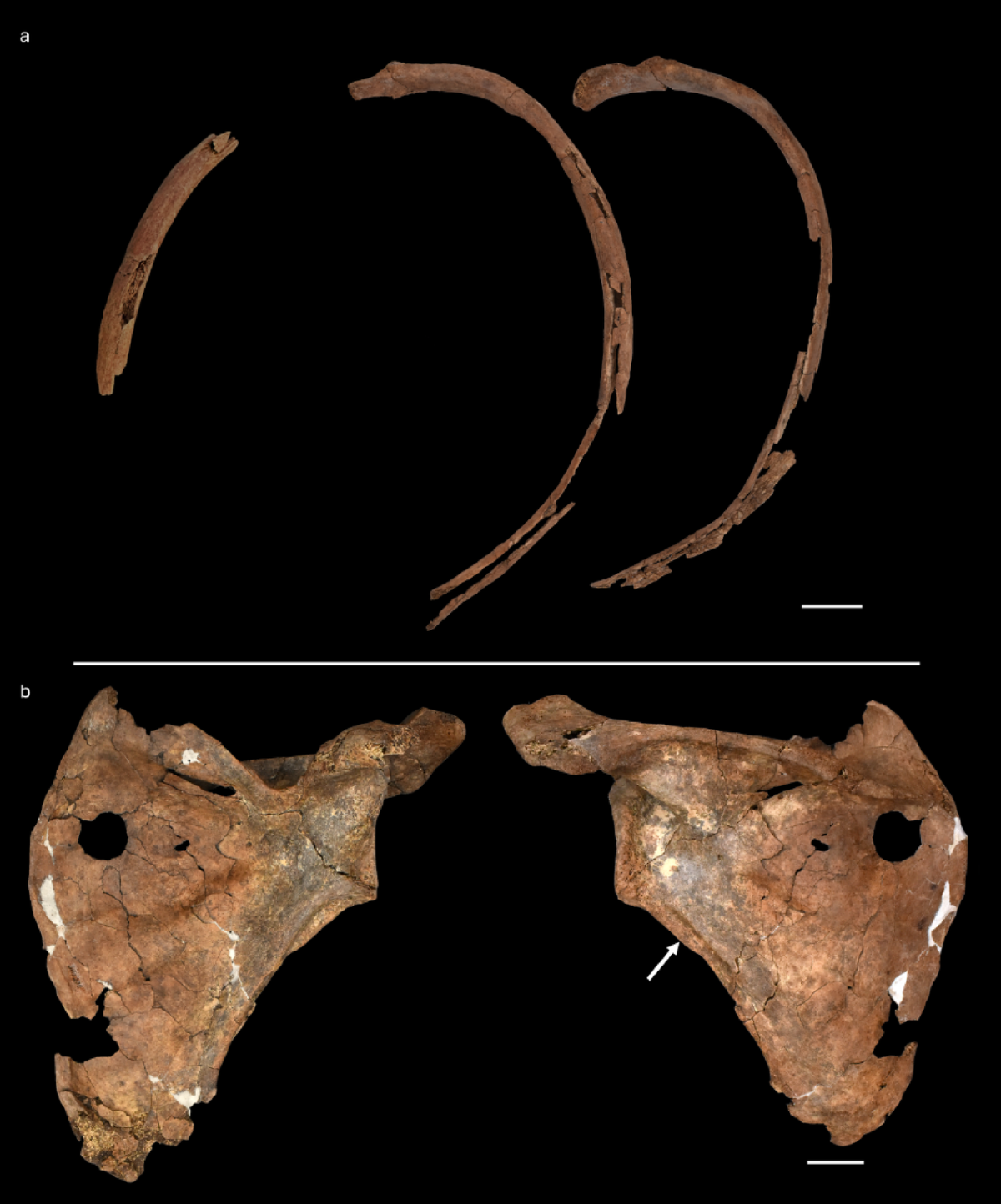
A nearly circular hole in a 75,000-year-old Neanderthal shoulder blade may preserve a fatal spear wound. Researchers studying the remains from Shanidar Cave in Iraqi Kurdistan consider a sharpened wooden spear a plausible explanation. They cannot determine whether the injury came from an attack or a hunting accident.
But a front tooth adds a different chapter. Split lengthways, it continued to accumulate tartar and wear after the damage occurred. The individual had survived an earlier, severe injury. The tooth records survival after serious harm.
The October 15, 2026 study calls the individual Shanidar A. Tooth wear suggests an age around 45; sex could not be estimated. The researchers attribute the hand, ribs, shoulder blade and six front teeth to one individual, while acknowledging that some remains could belong to others.
A fragment that fitted back into the hole
The perforation measures roughly 15 millimeters. Micro-CT scans revealed small bone fragments beneath it; a muscle-related ridge helped researchers fit one back into place. Its position, radiating cracks and the beveled opening support a penetrating injury around the time of death. There was no evidence of healing.
View the actual shoulder-blade figure.
The circular wound resembles experimental damage from round wooden points. No weapon was recovered. The authors say additional impact experiments are underway, so the precise mechanism remains under investigation. Neither a motive nor an attacker can be identified from these remains.
Cambridge University’s October 15 video introduces Emma Pomeroy’s analysis of Shanidar A. Its question about an attack remains an interpretation, not proof of a prehistoric murder.
Why an absent wooden weapon matters
The missing spear fits a larger archaeological problem: wood usually decays, leaving an incomplete picture of ancient technology. A 2024 PNAS study of Schöningen in Germany shows how dramatically exceptional preservation can change that picture.
Researchers identified 187 wooden artifacts at the site, including evidence for at least 20 hunting weapons. They also recognized 35 tools made from split wood, probably used in domestic activities. The assemblage demonstrated a broader range of woodworking than a handful of surviving spears might suggest.
That study challenges an archaeological record dominated by durable stone and bone. Wooden equipment could serve hunting, gathering and everyday work, yet disappear almost completely elsewhere. Schöningen preserves the objects themselves; an injury potentially made by wood provides a different, indirect kind of evidence. The comparison explains why researchers take the shape of a small hole seriously without treating it as a recovered weapon.
The researchers also identified wood-splitting techniques. Such work required more than picking up a convenient branch: the surviving objects preserve choices about materials and manufacture that would be invisible at a site where the wood had rotted.
The tooth records survival
In Cambridge’s account of the new research, Emma Pomeroy interprets the damaged incisor as evidence of survival for at least a year, possibly longer. The tooth remained in use after being split. Help with eating, perhaps through softer food, is inferred from the injury and survival, rather than directly observed.
There is independent context for that interpretation. Earlier research led by Penny Spikins at York examined recovery and survival among injured Neanderthals as a wider pattern, not just an isolated remarkable case.
One example was Shanidar 1, a different individual from the same cave, who survived for years with multiple serious impairments. The review argues that such survival likely involved food, protection and other assistance. Across cases, care could reduce the risks of lives spent obtaining food around dangerous animals and in demanding environments.
This makes assistance a potential part of group survival, rather than an inexplicable exception. It still does not reveal exactly who helped a particular individual, what treatment they used or what they felt. Those conclusions require more than evidence that an injury healed.
A careful distinction about the dead
Shanidar also offers a warning against turning suggestive evidence into an attractive certainty. Its famous “flower burial” interpretation connected ancient pollen with flowers placed around a body. A 2023 reassessment of the pollen evidence found that nesting solitary bees probably deposited at least some of those clumps.
Rejecting that explanation for the pollen does not erase the bodies themselves. The same study emphasized repeated placement of Neanderthal remains in a small area near a prominent boulder. Whether flowers accompanied a burial and whether people repeatedly returned to a location with their dead are separate questions.
The new study brings the cluster’s minimum to five individuals, four adults and an infant, strengthening the case that this particular place was repeatedly used.
That expanding archaeological record offers a firmer path forward than treating every attractive interpretation as an established fact.
Featured image: E. Pomeroy, in Pomeroy and colleagues, Scientific Reports (2026), CC BY 4.0. White areas are modern reconstruction material.