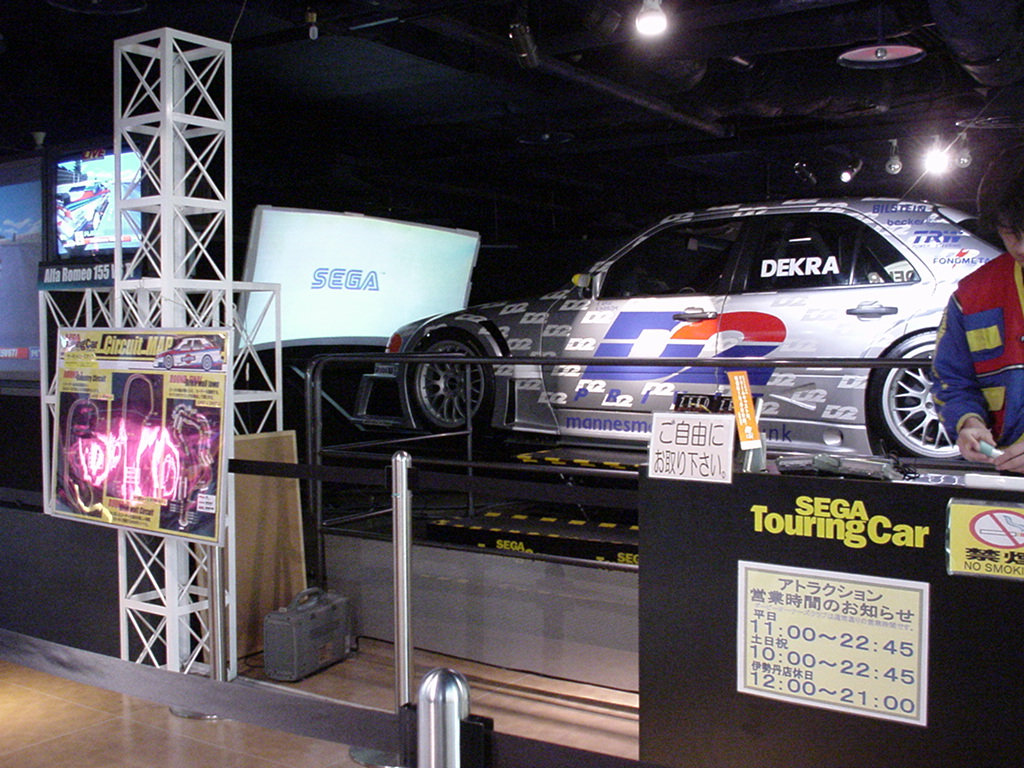
The arcade cabinet had four wheels, doors, a windshield and racing decals. In a photograph from Sega’s Kyoto Joypolis, a full-size touring car sits on a raised platform in front of a screen. The sign below it reads Sega Touring Car Championship.
That car was the game’s control cockpit. A newly released photography collection lets you examine the installation, then turn to another attraction in the same venue: a walk-through version of The Blair Witch Project, complete with a missing-person poster and the film’s stick figure on the wall. The photographs preserve an arcade where driving a virtual race and stepping into a horror film were offered under one roof.
The Video Game History Foundation introduced Colin Williamson’s photography collection on October 21, 2026. The images themselves are archival. Williamson took them while covering Japanese gaming culture around the turn of the millennium, long before these places and events became nostalgia. The car photograph belongs to a Kyoto Joypolis visit dated February 5, 2000.
A car-sized answer to arcade racing
Look at the photograph of the racing attraction and the scale becomes clear. The vehicle occupies a substantial part of the room. Barriers separate it from the surrounding floor, and its body carries the crowded sponsor markings of a competition car. A screen bearing Sega’s logo stands ahead of it. Even the opening-hours sign remains in the frame.
The archive’s catalog identifies the actual car as the control cockpit for the game. That is the important distinction: the photograph documents a playable installation, rather than simply a vehicle parked beside an arcade machine for decoration.
Kyoto Joypolis closed in August 2002, according to the archive. Alongside the photographs, Williamson preserved his admission ticket and the cover of a guidebook. Together, those small objects give the oversized machine an address, a date and a place in an ordinary visit.
The horror attraction in the same venue
The same Kyoto gallery contains a striking change of mood. Its Blair Witch entrance is dark, with tree silhouettes across the frontage, visitors gathered outside and a missing-person notice near the doorway. A large red stick figure hangs beside the entrance.
The catalog describes it as a walk-through attraction based on The Blair Witch Project. These photographs show the entrance, not what happened inside; they cannot tell us which scares visitors encountered. What they do preserve is the physical packaging: a horror story converted into somewhere people could queue, enter and explore, inside the same entertainment venue that offered the car-sized racing cockpit.
Shenmue brought the forklift
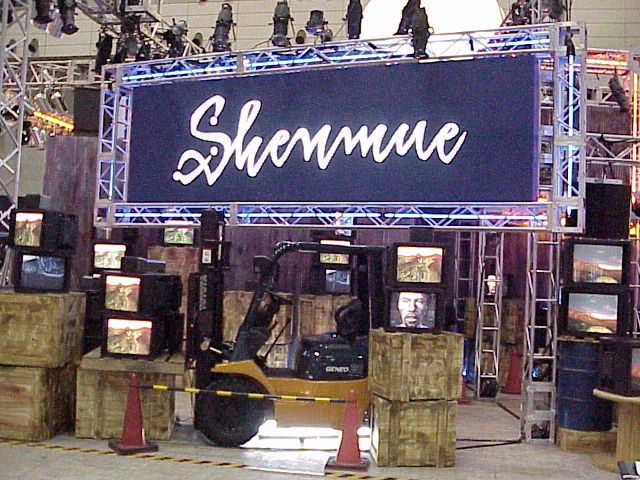
Williamson also photographed another wonderfully literal piece of game promotion. At the autumn 1999 Tokyo Game Show, the Shenmue booth contained a yellow forklift.
The vehicle sits beneath a huge Shenmue sign, surrounded by stacked crates and small television screens. The booth looks part trade-show exhibit, part loading area. The image makes its point without a trailer or a press release: someone gave this game a physical setting on the exhibition floor.
It also preserves the less glamorous texture that polished promotional images tend to lose. There are support trusses, cones and a striped barrier in front of the display. You can see how the fantasy was assembled.
A launch-day ticket and an unexpected assignment
Other records bring the collection down to human scale. At an Osaka Toys “R” Us, Williamson arrived so early for the PlayStation 2’s March 4, 2000 launch that staff gave him a redemption ticket and let him return later. The launch-day archive preserves that ticket, photographs of the event and a sign indicating the store had sold out of consoles.
Then there is the April 8, 2005 Electroplankton event at Tokyo’s Laforet Museum. The catalog records a panel with designer Toshio Iwai, Shigeru Miyamoto and Satoru Iwata, alongside a retrospective containing material for Iwai’s unreleased Sound Fantasy.
It also explains why the collection includes photographs of Miyamoto’s shoes: Williamson says IGN writer Anoop Gantayat had asked him to pay attention to people’s footwear. An unexpectedly specific reporting assignment survived alongside a piece of Nintendo history.
The collection is available to browse. Start with the car, but leave time for the surrounding details. A machine can survive in a screenshot of its game. These photographs preserve the much stranger world around it.
Featured photograph: Sega Touring Car Championship at Kyoto Joypolis in 2000. Credit: Colin Williamson and the Video Game History Foundation. Reproduced unchanged for educational coverage under the collection’s published permission.