RKO cut about 43 minutes from Orson Welles’s The Magnificent Ambersons, and the original reels are reported lost and likely destroyed. Now producer Edward Saatchi wants to rebuild those missing passages with AI. The distinction is crucial: Fable’s project would create new scenes from surviving documents and performances. It would not recover Welles’s original footage.
That proposal reopens one of classic Hollywood’s most haunting “what if?” stories. The released 1942 film is 88 minutes long; the longer version Welles had assembled was cut down, reshaped and given a different ending. Continuity pages, storyboards and still photographs preserve clues about what was removed. They can guide a reconstruction—but they cannot turn a new interpretation into the lost movie itself.
What happened to the missing minutes?
Welles made The Magnificent Ambersons after Citizen Kane, adapting Booth Tarkington’s novel about a wealthy family losing its place as a changing city and new technology move past it. After Welles left for Brazil to work on another film, RKO reworked the picture following previews. The studio shortened it, filmed replacement material and released an 88-minute version in July 1942.
The exact number depends on which version and measurement a source uses. AFI’s catalog says the release print differed substantially from a film of nearly 132 minutes and was missing almost 45 minutes. Recent reporting and the proposed reconstruction commonly refer to about 43 lost minutes. Either way, a substantial portion of the longer cut disappeared from the version audiences could see.
The original reels are generally believed to have been destroyed, although the surviving record is more complicated than “nothing remains.” AFI notes that a cutting continuity copied from the screen, storyboards and stills from deleted material survive. The continuity, dated March 12, 1942, records shots and dialogue; these documents offer researchers a remarkably detailed map of material that is no longer available as complete scenes.
A reconstruction is not a restoration
That paper trail is what makes the new project possible. Filmmaker Brian Rose began an animated reconstruction in 2019 using the continuity and other surviving material. Saatchi, who leads Fable Studio, brought Rose in as a consultant and assembled a team to try a different approach. Le Monde reports that the team has filmed modern performers and plans to use their movement, facial expressions and digitized voices in AI-assisted scenes modeled on the original cast.
That process may let viewers picture how a missing passage could have played. It cannot recover the photographed performances, editing choices or exact images Welles made. It also cannot settle every question in the script and continuity. A reconstruction fills gaps by making choices, and those choices belong to the new filmmakers.
There is another important wrinkle: the roughly 131-minute version was not necessarily a finished director’s cut. Sorbonne-Nouvelle film scholar François Thomas told Le Monde that it was a working print Welles still planned to revise. So a new version based on that material would not simply reveal “Welles’s final version.” It would offer a modern interpretation of the record of a work in progress.
The project still needs rights—and trust
Fable’s first public announcement drew objections because Saatchi had not secured the film rights or contacted Welles’s daughter, Beatrice Welles, before announcing the plan. Warner Bros. controls the relevant RKO rights, according to Le Monde and The New Yorker. A representative for the rights holders criticized the original announcement; Beatrice Welles said she was a purist and skeptical, while also saying she appreciated the team’s respect for her father’s work.
That relationship has since warmed, Le Monde reports, but approval is not settled. Saatchi said he hopes to bring Warner Bros. and Beatrice Welles on board and floated a possible Cannes screening in 2028 as a personal dream—not a confirmed booking or release date. Without the rights holder’s permission, the project remains an academic exercise rather than a cleared commercial restoration.
What fans could actually see
The movie’s lost footage has long invited cinephiles to imagine the film RKO removed. A careful reconstruction could make the continuity, storyboards and stills easier to understand by putting them into motion. That would be a fascinating piece of film archaeology, especially if the finished work clearly labels what is documented and what has been generated.
But no AI system can return the specific images Welles photographed or tell us exactly how he would have finished editing. The real payoff may be more modest and more honest: a chance to see a new interpretation of the evidence, beside the 88-minute film that survives. That is still a remarkable thing to attempt—provided the reconstruction is never mistaken for the lost original.
Sources: Le Monde, October 3, 2026; AFI Catalog; The Criterion Collection; The New Yorker, February 2, 2026.
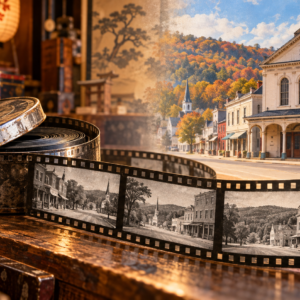
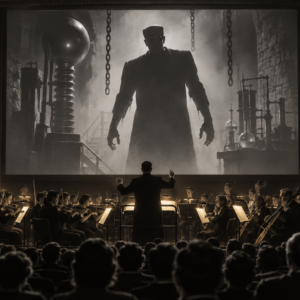
Featured image: original illustration of missing film and a proposed reconstruction workflow; it is not recovered footage, an original Welles scene or a depiction of his final intended cut.