
At full speed, the little snake shoots across the frame so quickly that its escape looks almost like a visual trick. The replay is where things get wonderfully strange: its body rises into loose, upright loops, then swings through another rolling stride instead of settling into the familiar side-to-side slither.
The roughly half-minute research clip includes normal-speed footage followed by replays labeled eight-times and sixteen-times slow motion. It is a simple laboratory side view, not a polished wildlife film, but those slower passes make the movement worth watching.
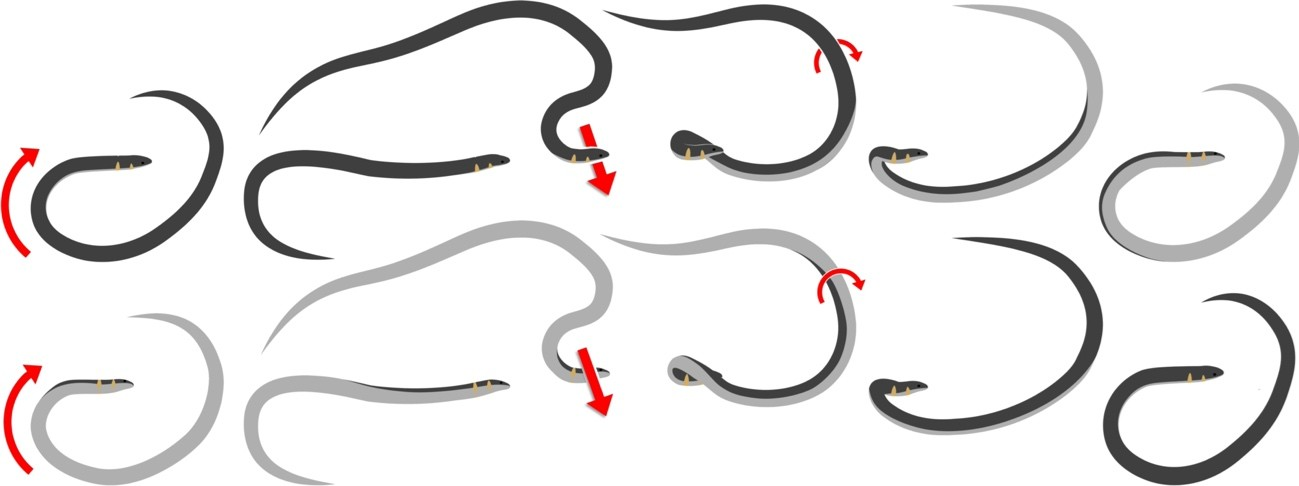
According to Toho University, dwarf reedsnakes from Southeast Asia use this rolling escape to get away from potential predators. A study published in Current Biology on October 19 examined the mechanics using recordings from multiple angles.
The crucial detail is that the snake does not rotate its entire body like a wheel. It alternates which side touches the ground, then swings an arched section down beside its head. Meanwhile, the head remains pointed along the direction of travel and comparatively steady in height, especially during faster movement.
Researchers measured peak rolling speeds of 1.72 to 3.69 meters per second, roughly four times the peak speed measured during ordinary lateral undulation. The snakes could also negotiate a track only 20 centimeters wide.
That is what makes the footage more interesting than a snake doing a funny trick: the animal combines rapid rotation with a head that stays oriented, potentially helping it control a very fast getaway. Watch the slow-motion passes with your attention on the front end, not just the looping body.
The study is new; the linked research video was uploaded in August. Featured photo: Pseudorabdion saravacense, one of the dwarf reedsnakes investigated in the study. Photo: Yosuke Kojima.