The von Trapp family did not escape Austria by hiking over the mountains into Switzerland. They left by train, carrying few belongings, and traveled first to Italy. That may be a quieter ending than the one in The Sound of Music, but it is only the most visible of several ways the beloved musical reshaped their story.
The film grew from Maria von Trapp’s memoir, but the National Archives notes that the adaptation changed and omitted many details. The real history still has the music, a family facing political danger, and a decision to leave home. The differences are specific—and they make the people behind the songs feel less like storybook characters.
Movie vs. reality: Maria came to tutor one child
In the film, Maria arrives as governess to Captain von Trapp’s seven children in 1938. The historical record says she came to the household in 1926 to tutor one child: Georg’s daughter Maria, who was recovering from scarlet fever and temporarily could not attend school.
That change reshapes the whole opening of the musical. The movie gives Maria an immediate role in transforming the household; in real life, she was hired for a specific teaching job, and the family’s musical life had already begun. The National Archives says the von Trapps were musically inclined before Maria arrived, though she did teach them madrigals. A nun and tutor entering one child’s life is a different starting point from a governess being sent to manage seven.
Movie vs. reality: Georg was not the cold, whistle-blowing tyrant
The musical’s stern father gradually rediscovers music and warmth through Maria. The National Archives and the family’s own history account describe a different Georg: his children remembered him as loving, attentive and gentle, and he enjoyed musical activities with them. He did use a boatswain’s whistle to call the children, but the family account says it was playful and connected to teaching them safety around boats—not a device for enforcing military discipline at home.
This is more than a personality tweak. The movie needs a household transformed by Maria; the real family already had affection and music, even as it faced grief and financial and political pressures. The film’s emotional arc belongs to the film. The archive-backed family portrait is less tidy, but no less human.
Movie vs. reality: their marriage was not a 1938 romance
Maria and Georg married in 1927, eleven years before the family left Austria. The musical compresses the relationship and the political crisis into a much shorter story. It also presents their romance in familiar movie-musical terms. Maria’s own memoir, as quoted by the National Archives, says she was initially unsure about marrying Georg and was not in love with him at the time; she loved the children and later came to love him deeply.
The timing matters. Maria was not brought into the home just before the Nazi takeover, then swept into a quick courtship and escape. By the time the family departed in 1938, she and Georg had been married for more than a decade, and their household included children from both of Georg’s marriages.
Movie vs. reality: the family took a train to Italy
The screen version turns the family’s departure into a secret trek over the Alps toward Switzerland. In the account cited by the National Archives, the family left by train, with few belongings, and went to Italy. Maria later said they told people they were going to America to sing and did not climb over mountains with suitcases and instruments.
The von Trapp family’s own FAQ likewise says they departed by train under pending performance arrangements abroad. They had already been singing professionally, and their next steps were tied to a booking opportunity. The escape was real; the movie’s route and staging were not. “They went over the mountains” is a powerful final image, but it is not what happened.
Movie vs. reality: seven children became ten, and the music had another director
The film centers on seven children. Georg’s first marriage had seven children, and Maria and Georg later had three more, making ten in all. The names, ages and birth order were also changed for the stage and screen versions.
The musical’s Max Detweiler is fictional. The National Archives identifies the family’s priest, Reverend Franz Wasner, as their musical director for more than twenty years. The film’s musical transformation is still a lovely piece of storytelling; the real singers’ history simply had a different cast of people behind the scenes.
The movie can be beloved and still be a rewrite
These corrections do not make The Sound of Music less meaningful. They show what adaptation does: condense years into a stage-ready romance, turn a complicated father into a clear dramatic obstacle, and give an escape a memorable visual climax. The film keeps the broad truth of a musical family leaving Austria as danger grew, while changing the route, chronology, family size and relationships to make one coherent story.
The real family’s account is not a checklist for catching the movie out. It is a second story worth knowing: a tutor hired for one recovering child, a marriage that began years before the crisis, a father remembered differently by his children, and a family that boarded a train instead of climbing a mountain pass.
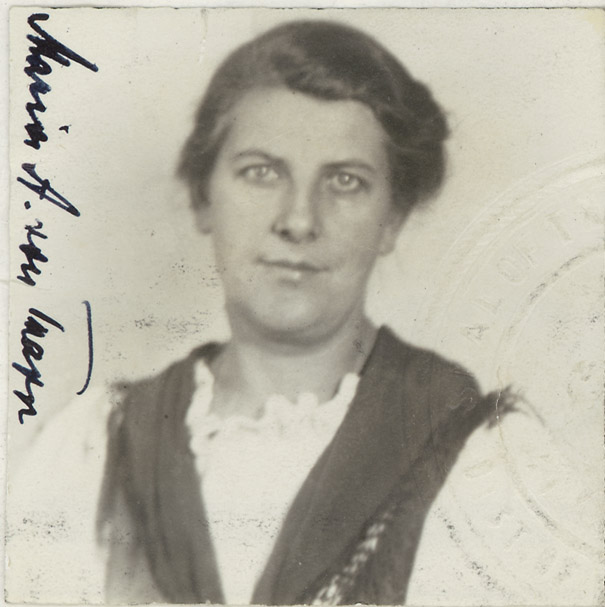
Sources: National Archives, “Movie vs. Reality: The Real Story of the Von Trapp Family”; von Trapp family history FAQ; National Archives photograph of Maria von Trapp, from her 1944 Declaration of Intention.
Featured image: original symbolic illustration comparing the film’s mountain-escape imagery with the documented train departure. It does not portray the real family or an actual historical scene.