Brian May has spent decades making arenas feel enormous. Now the Queen guitarist and astrophysicist has helped make a 780-meter asteroid feel close enough to reach out and touch—even though it was photographed roughly 197 million kilometers from Earth.
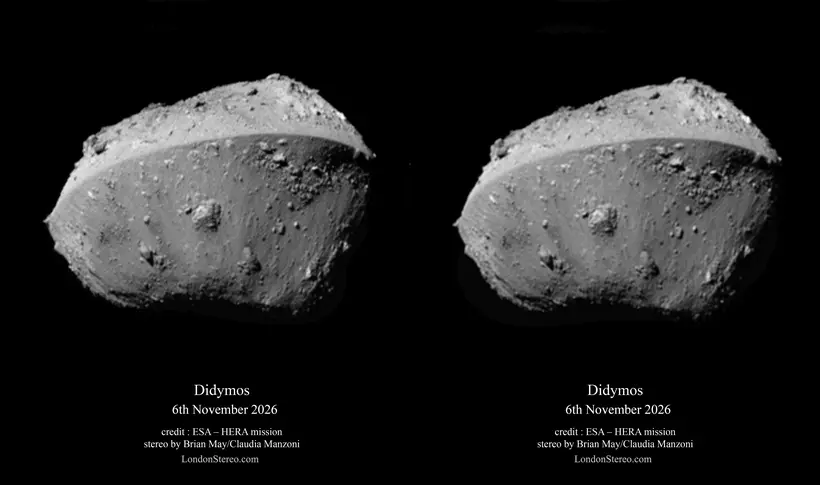
May and stereoscopy specialist Claudia Manzoni turned two nearly adjacent images from the European Space Agency’s Hera spacecraft into three-dimensional views of Didymos, the larger member of the binary asteroid system that also contains Dimorphos. The payoff is not merely a handsome space picture. With the depth effect working, Didymos’s sharp, unusually smooth equatorial ridge stands apart from the boulder-strewn terrain covering much of the rest of the object.
How two flat spacecraft images became one deep asteroid
Hera’s Asteroid Framing Camera captured the source images on November 6, 2026, while the spacecraft was circling the system from about 29.7 kilometers away. Each pixel represented roughly 2.8 meters of the asteroid’s surface, according to ESA’s November 19 release.
The two frames were taken only moments apart, but Hera’s motion changed the viewing angle just enough to mimic the slightly different perspectives received by a person’s left and right eyes. May and Manzoni aligned those views so the brain can combine them into a single scene with depth.
ESA released three ways to try it. The red-and-cyan version works with matching 3D glasses. The cross-eyed pair asks viewers to overlap the two images by gently crossing their eyes. A third parallel-view pair works by relaxing focus and looking “through” the image. The last two techniques can take patience; if your eyes vote to unionize, the color-glasses version is the friendlier route.
The strange ridge is more than a visual trick
The illusion is fun, but the terrain it emphasizes matters to researchers. Didymos has a spinning-top shape and rotates once every 2.2 hours. Hera principal investigator Patrick Michel has said that the rapid spin may encourage loose material to migrate toward the equator, helping build the prominent ridge.
Seen as a flat photograph, the asteroid can read like a lumpy gray disk. In stereo, the ridge projects forward, its smoother outline contrasting with rougher regions. That separation helps scientists judge shapes and relationships that are harder to interpret from brightness alone. Michel described stereo pairs as both spectacular and scientifically meaningful because they make researchers feel as if they are present at the asteroid.
Hera is also examining Didymos with more than ordinary visible-light vision. Its HyperScout H instrument observes the surface in 25 bands ranging from visible red into near-infrared, while a Japanese thermal imager maps temperature differences. Those measurements can help distinguish solid or fractured rock from looser debris and offer clues about surface composition. ESA’s instrument overview shows how the same asteroid changes across those wavelengths.
Why Hera is investigating a cosmic crash scene
Didymos itself was not hit, but its 151-meter moonlet Dimorphos was. In September 2022, NASA’s DART spacecraft deliberately slammed into Dimorphos at about 6.1 kilometers per second. The impact shortened the moonlet’s orbit around Didymos by roughly 33 minutes, proving that a spacecraft could measurably alter an asteroid’s motion.
Hera arrived to turn that dramatic demonstration into a repeatable planetary-defense technique. By measuring Dimorphos’s mass, structure, impact crater and altered orbit, the mission can help researchers calculate how efficiently DART transferred momentum. That is the difference between knowing a method worked once and understanding how to apply it to a future threat with different size, composition or internal structure.
The new stereo views do not yet show the transformed Dimorphos in detail; ESA says the moonlet is largely hidden in shadow in the early imagery. The agency plans to unveil closer views on November 25. For now, May’s reconstruction gives the larger asteroid a startling physical presence and demonstrates why depth perception remains useful even when the “eyes” are a robotic camera flying through deep space.
A rock star with a long view of space
May’s involvement is not a celebrity cameo. He earned a doctorate in astrophysics and has long advocated for stereoscopic imaging through the London Stereoscopic Company. He and Manzoni previously made 3D views from Hera’s 2025 flyby of Mars’s moon Deimos, and those images later aided research into that moon’s past.
That combination of astronomy and visual craft is what makes this result click. Hera supplied two precise slices of data. Stereoscopy transformed them into a view our depth-hungry brains can interrogate almost instinctively. The asteroid is still unimaginably far away, but for a moment it stops looking like a dot in a textbook and becomes a place.
Featured image credit: ESA, “Hera HyperScout H image of Didymos asteroid,” used under CC BY-SA 3.0 IGO. The featured image shows the same asteroid in multiple wavelength bands; it is not one of May and Manzoni’s stereo pairs.