Rødhals Man spent childhood eating from the sea, as generations of hunter-gatherers had done around Denmark’s Sejerø archipelago. By adolescence, however, a chemical record locked inside one of his teeth shows that food from land had become a much larger part of his diet. He died roughly 6,000 years ago, just as farming communities were establishing themselves nearby.
That shift turns one skeleton into something archaeology rarely provides: a life story unfolding across a major historical transition. A new open-access study in Antiquity combines ancient DNA, radiocarbon dating and several kinds of isotope analysis to place Rødhals Man at the meeting point between Denmark’s coastal foragers and its first farmers. The evidence does not prove he became a farmer. It suggests he kept his inherited way of life while adopting—or at least eating—some resources connected with the new world arriving around him.
A skeleton that never fit the timeline
Residents found the nearly complete skeleton in 1956 while digging in a shell midden on the island of Sejerø. Archaeologist Ole Klindt-Jensen recorded and recovered the burial in pouring rain. The man had been laid on his back beneath an intact layer of shells, with two large stones bordering the grave.
For decades, the remains presented a problem. Earlier chemical work indicated a marine-heavy diet typical of Denmark’s Late Mesolithic fishing and hunting communities. Yet radiocarbon results placed the man in the Early Neolithic, after farming had arrived and marine food had nearly disappeared from the chemical signatures of Danish human remains.
The new analysis addresses that mismatch more carefully. Marine foods contain “old” carbon that can make remains appear older than they really are. Researchers reconstructed how much of Rødhals Man’s food came from different environments, corrected for that marine reservoir effect and estimated that he most likely died between 3890 and 3770 BC.
That date matters because the first farmers were entering Denmark during his lifetime.
His tooth preserved a dietary timeline
Bones average dietary signals across long periods, but teeth can preserve a sequence. The researchers sampled dentine from Rødhals Man’s lower-right first premolar in small increments, effectively reading chemical changes laid down as the tooth developed.
The earliest portions match a childhood diet dominated by marine resources from shallow coastal environments. Fish, shellfish and possibly marine mammals fit both the isotope evidence and what archaeologists know about Ertebølle Culture communities living around eelgrass meadows.
From adolescence onward, the signal moves toward substantially more food from land. He never abandoned the sea, and the researchers cannot identify individual meals. The terrestrial contribution could include hunted animals and gathered plants. However, his sustained adult pattern differs from other known Mesolithic individuals, and it emerged when domesticated cattle, sheep and crops were appearing in the region. The authors therefore argue that farmed food is the most likely explanation.
The fascinating part is not a clean conversion from fisherman to farmer. It is the mixture. Rødhals Man seems to have remained deeply connected to the coastal economy while participating in a changing food system.
His ancestry stayed local while his world changed
Ancient DNA adds another piece. Rødhals Man carried Western Hunter-Gatherer ancestry without detectable farmer admixture, making him the most recent securely dated individual currently known in Denmark with both unadmixed Mesolithic ancestry and a coastal forager’s dietary signature.
That description should not be turned into a claim that he was “the last hunter-gatherer.” Archaeology rarely grants titles that absolute. It means he is the latest securely dated example identified so far within the study’s evidence.
Even his burial hints at cultural contact. It lacks the red ochre common in many Late Mesolithic graves and uses a stone arrangement more similar to early farming burials. A bone object found near his arm was later discarded after being reclassified, but the researchers note that it may have been an archer’s wrist guard comparable to objects from early Neolithic graves. Because the artifact is gone, that possibility remains unresolved.
What one life can—and cannot—tell us
The study also reconstructs a physically demanding life. Rødhals Man stood about 1.55 meters tall, died in his thirties and had skeletal changes associated with heavy use of his arms, wrists, knees and calf muscles. The authors suggest that repeated paddling may explain some of the wear, although bones cannot supply a daily schedule.
His genome, diet and grave do not reveal what he thought about the newcomers, whether exchanges were friendly, or whether he personally tended crops or livestock. They do show that the transition to farming was not only a population chart with one group replacing another. For at least one person, it was a change that entered the body gradually.
Rødhals Man grew up on food gathered from the sea. Later, land-based food became more important while his ancestry and much of his coastal lifestyle remained continuous. That is the reader payoff hidden in the tooth: the Neolithic revolution, usually compressed into a broad arrow on a timeline, appears here as an adjustment made during one human lifetime.
Primary sources: the open-access Antiquity research article and the University of Gothenburg research announcement.
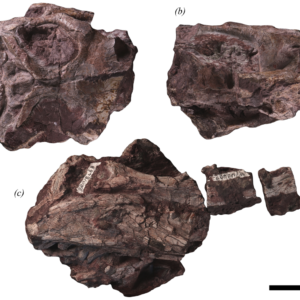
Featured image: Figure 1 from Fischer and colleagues, showing the cranium of Rødhals Man. Photograph courtesy of John Lee, Danish National Museum, and Anders Fischer. Reproduced from the open-access study under CC BY 4.0.